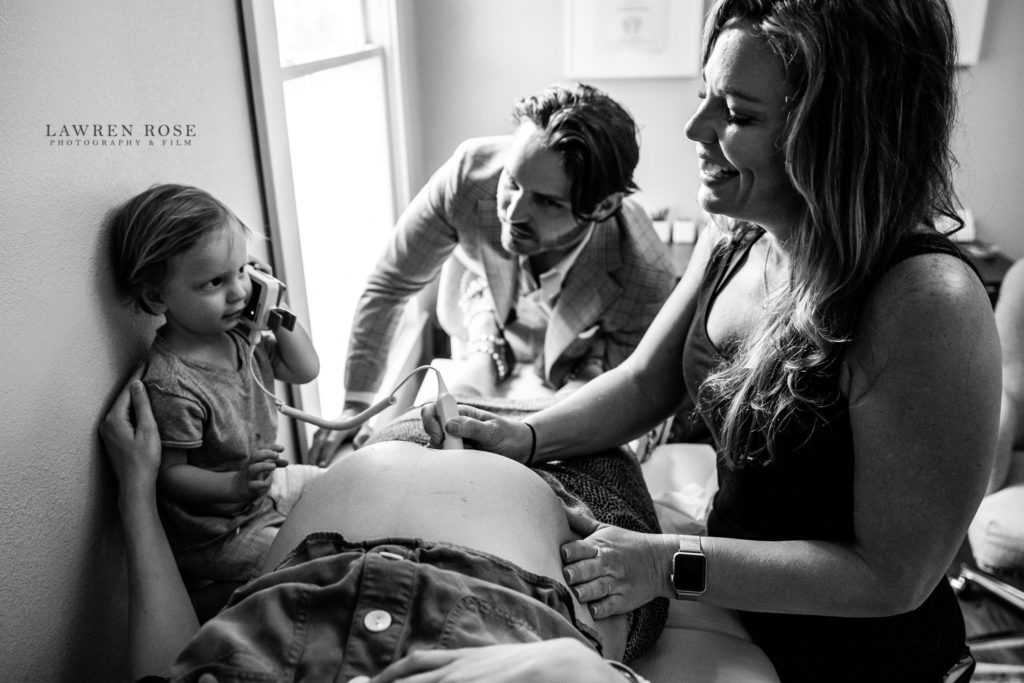
Have you ever wondered what out-of-hospital birthing looks like? For me, I was very curious and can tell you that the birthing center atmosphere immediately put me at peace. Birthing centers typically offer very homey, spa-like environments, filled with professional and certified midwives, and other birth workers, like doulas and birth educators. They are stocked with medical equipment and everything needed to safely birth out of the hospital naturally. And the same goes for home birth if you choose that route. They bring everything to you! The only difference is the setting.

With COVID-19 haunting us, birth centers are reporting higher-than-average inquiries. For my center, they’ve been flooded with moms looking to transfer to out-of-hospital care during this pandemic. And I know many women are curious about the benefits of birthing center and home births, so my midwife, Becky Hines, LM, CPM, with Dallas Birth, was gracious enough to answer your questions.

- What is the C-section rate for moms who plan to do a birthing center birth or a home birth?
We do not perform C-sections in an out-of-hospital setting.
In the U.S., roughly 1 out 3 women have C-sections who have their babies in the hospital.
For women who plan to have an out-of-hospital birth, the hospital transport rate overall is roughly 10% (Cheney, 2014). But out of that 10%, not all of those women have C-sections.
- Do you still have an OB at a birthing center or home birth?
No, we do not have an OB at the birthing center or a home birth.
Dallas Birth and several other area midwives have OB’s that we collaborate with or have the ability to do co-care with, but they do not attend the birth.
We typically have 2-3 midwives at each birth – one midwife for mom, one midwife for baby, and one midwife charting.
- What is the plan if something goes wrong during an out-of-hospital birth?
As midwives, we spend countless hours in trainings, workshops, drills, and continuing education, not to mention the routine care of our clients that we do. Midwives are required to have their Neonatal Resuscitation Certification, as well as being CPR certified.
We are well trained in how to handle an emergency should one take place. In the state of Texas, licensed midwives are also allowed to carry certain medications, should an emergency arise. We do carry resuscitation equipment and oxygen, too. Our birth center has protocols set in place with the hospitals. If we need to transport a mother or baby, the Labor and Delivery team at the hospital will be notified ASAP so that they can be ready for us. Our birth center is just 2 minutes from the closest hospital. We do like to make sure that our home births are close to an area hospital, as well.
- What are some of the challenges that interventions and epidurals/narcotics can cause for mom and baby during and after labor? See below!
- What are some of the benefits of having an unmedicated delivery?
An unmedicated birth has so many benefits; however, we also know that sometimes interventions can be helpful or even save lives. With that being said, the majority of births do not need “help” or medical interventions.
Here is a list of a few benefits of an unmedicated birth:
- Freedom of movement. You are not tied down with a bunch of wires and monitors. Also, if you have an epidural or even narcotics, you are confined to your bed. Freedom of movement makes labor easier to manage and sometimes allows labor to progress faster.
- During an unmedicated birth, oxytocin is released and sends signal to your uterus to contract and it sends signals to your brain to release endorphins, which is considered nature’s pain killer. Epidurals, IV fluids, and narcotics can all interfere with these hormones and slow your labor down.
- One intervention often causes a “domino effect.” One intervention often leads to another, which leads to another, etc. For example, if a mother decides to receive an epidural, it can slow down labor due to the medication and the IV fluids. Sometimes the synthetic hormone, Pitocin, is then recommended to get labor to start progressing again. It may also be recommended to artificially break your water, which increase your risk of infection and may potentially cause you to be on the proverbial “time clock.” C-section rates also increase once an epidural is given because of scenarios like the above. When you can “leave things alone” and let the mother instinctively labor without unnecessary intervention, it can give her the opportunity for a shorter, easier birth.
- Narcotics can cause adverse effects to baby such as: central nervous system depression, respiratory depression, impaired early breastfeeding, decreased ability to regulate temperature, altered neurological behavior. Narcotics can also cause adverse side effects to mom such as: grogginess, nausea and vomiting, feeling disconnected or “out of it” or itchiness. Choosing not to have any narcotics or an epidural can allow mom to be fully present during the birth.
- Newborns tend to be much more alert and content, they tend to breast feed better, and their temperature, blood sugar, heart rate, and respirations tend to be more stable. The more that is pumped into your body, the more that baby has to recover from. Newborns also tend to have better gut flora, as well.
- It is a much easier recovery for mom! Many moms are up and walking shortly after birth. Many will even take a shower. There is a natural oxytocin high that mothers have immediately following a natural birth that tends to give them a boost of energy and to bond well with their baby. In contrast, it can take several hours for an epidural to wear off or you may feel groggy from the narcotics. The need for pain medication is much less following birth because of the lack of intervention that was needed.
- It’s less expensive! So let’s be real, having a baby is expensive. Depending on your insurance plan, having a baby in a hospital can very expensive. You are looking at fees owed to your OB for prenatal care, the birth, and postpartum, the hospital fees (which vary depending on what type of delivery you had and all of the procedures and services provided) and the anesthesiologist fee. It can certainly add up. Midwifery care can be significantly less.
- It is empowering! So many moms will say afterwards, “I can’t believe I did it!” It gives many moms a sense of accomplishment and pride. It is also very impressive to their partners, as well.
- What are the best ways to reduce pain in an unmedicated labor?
Hire a doula! A serious game changer, especially for first-time moms. They are worth every penny. Doulas have a lot of tips and tricks up their sleeve to help you manage labor. Also, hydrotherapy shows to decrease discomfort by 40%. Water is referred to as the “Midwife’s Epidural.”
A big benefit of an out-of-hospital birth is you have freedom to MOVE and change positions. Movement helps labor to progress and helps the mother to manage her discomfort in labor. It is very difficult to be hooked up to a bunch of wires, being stuck in bed, and trying to manage contractions.
- What are the best tips for inducing labor naturally?
This one is tricky. Every midwife has their own method and protocols. Also, every situation is different, so there really isn’t a “one size fits all” natural induction method.
- What are some tips for a first time mom birthing at a birth center?
LISTEN TO YOUR MIDWIFE! The number one reason for transport to the hospital is due to maternal exhaustion. We always tell our clients to rest, eat, and hydrate in early labor. You have to reserve you energy for active labor. I always refer to the analogy of the distance runner that comes out of the gate sprinting. That runner will run out of steam in the beginning and won’t have any reserve left to finish the race.
Also, we always tell our clients to not hyper-focus on the timing of contractions early on. It will wear you out mentally and, in turn, physically. Time a few here and there when your midwife suggests to.
Keep your circle small. Studies show that women labor much more effectively when it is just her and her partner. At most birth centers, visitors are allowed at the birth, but don’t be surprised if the midwives gently ask family members to give the couple space, especially if labor is stalling or if they are becoming a distraction to mom.
BE FLEXIBLE with your “Birth Plan.” Just like a wedding, birthday party, or other big event, birth hardly ever goes EXACTLY how you want. Are you REALLY wanting a water-birth? Great! However, you may dip your toe in the water during labor and hate it! Are you really set on having your partner catch the baby? Okay, we will do our best; however, once baby starts to emerge, your partner may change his/her mind. Or we may need you to change positions. Bottom line is, keep your mind open. Birth will progress much better that way and, in the end, you will be much happier.
Lastly, HIRE A DOULA!
- What are some of the top things you recommend a mom brings for a birthing center delivery?
All of the medical supplies and things needed in your Birth Kit are included (this may vary with each birth center, so be sure to ask); however there is a list of things that we ask you bring.
The top things are:
- 2 outfits for mom and baby
- Swim suit for mom and partner
- Hair ties and shower cap (nothing is worse than wet hair and laboring)
- Snacks
- Water bottle
- Toiletry bag for mom and partner
- Massage tools and oils
- A great playlist in case you want music
- Diapers
- Phone and charger
- Car Seat
For more information on Dallas Birth, visit DallasBirth.com.